
Seamounts and the Oxygen Minimum Zone (OMZ) are two typical deep-sea habitats that often coexist. However, it remains unexplored and unconfirmed whether the "seamount effect" alters OMZ structure through marine stratification, thereby influencing the deep-sea hypoxic environment and carbon sink processes.
To address this knowledge gap, a research team led by Prof. SONG Jinming from the Institute of Oceanology of the Chinese Academy of Sciences (IOCAS) clarified differences in the "seamount effect" across two cruises over M4 Seamount in the Western Pacific, finding that seamounts promoted OMZ expansion to a certain extent.
Their findings were recently published in Progress in Oceanography.
During the two cruises, the researchers observed clear uplifts of isotherms and isohalines near the summit of M4 Seamount, accompanied by nutrient upwelling. The average particulate organic carbon (POC) concentration near the summit during Cruise 1 was 1.99 times that during Cruise 2, indicating the "seamount effect" occurred in both cruises and was stronger in Cruise 1.
Using 3.2 mg/L as a threshold, the researchers noted that OMZ ranges and intensities were similar between Cruise 1 and Cruise 2, and that the OMZ in this region represents a typical Mild OMZ.
The team also proposed two possible mechanisms by which seamounts influence the OMZ. First, the hydrodynamic effect of topographic obstruction: upwelling triggered by the seamount lifts low dissolved oxygen (DO) isolines, shifting the upper boundary of the OMZ upward and expanding its vertical range. Second, the biogeochemical effect of organic matter degradation: corals, benthic organisms, and decomposition of organic matter enriched at the seamount base continuously consume DO, creating local hypoxia and thereby expanding and intensifying the lower boundary of the OMZ.
"Our research will provide a reference for advancing the understanding of seamounts and the OMZ," said Prof. MA Jun, the study's first author.
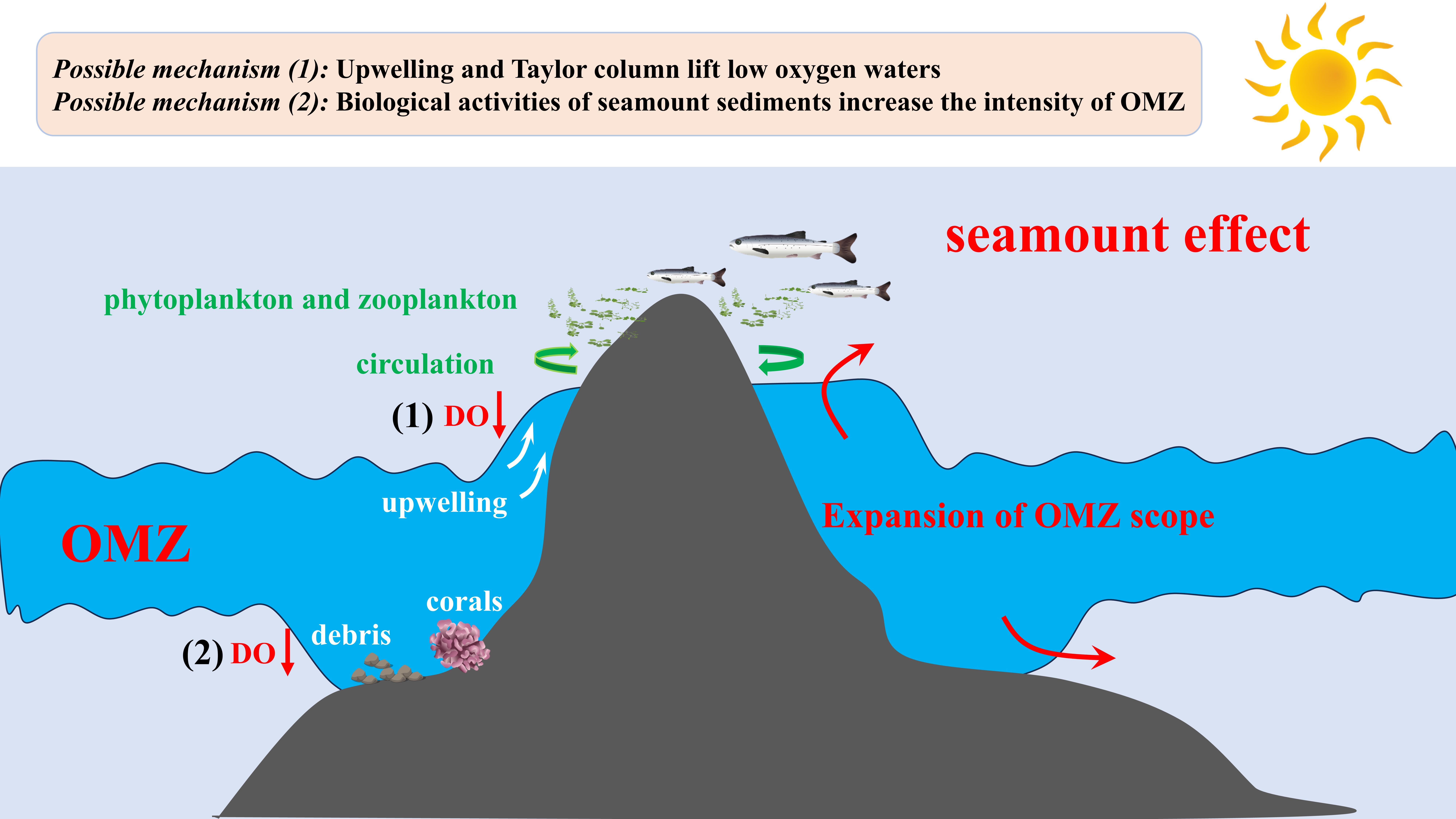
Schematic diagram of the potential impact mechanism of seamount on OMZ expansion. (Image by IOCAS)

86-10-68597521 (day)
86-10-68597289 (night)

52 Sanlihe Rd., Xicheng District,
Beijing, China (100864)
Copyright © 2002 - Chinese Academy of Sciences


